
01The position
Calls and puts don't tell you who owns them.
Naive GEX assumes market makers own the calls and are short the puts. Customers can buy calls and sell puts too.
Reverse the position and you reverse the implied hedge.
First, how market makers hedge an option. Then real positions, read by strike, so you can see how that hedging is likely to show up in a live session. Then your own trades, fitted to it.
The foundation is free. The rest builds on it.


Three parts, in order. Each one is only possible because of the one before it.
Start with one option: how a market maker hedges it when it trades, and how that hedge changes with price, time and volatility. These are the first principles, and they are free.
Take the whole market maker position, strike by strike, and work out how the hedging is likely to show up on an actual day, in a live market.
Fit your own strategies to what the position says: the trade, the structure and the size that suit the day, rather than a forecast.
The course runs in three parts. First the principles: how a market maker hedges one option, and how that hedge changes with price, time and volatility. Then real positions, read by strike, and how the hedging flow is likely to show up on an actual day in a live market. Then your trading: adapting what the position says to your own strategies, responsibly, rather than to a forecast.
Today's range boundaries and where price is likely to settle.
If a boundary breaks, reset into the new range the same way.
Entries and exits from vanna and how volatility tracks SPX.
Notice when the edge behind a trade is no longer there.
The first part, how market makers hedge one option, is free. Everything after it is built on that. Learn it first, and judge the teaching before you buy the rest.
You've probably had a day like this. The gamma chart showed support, so you held, and SPX went through it without slowing down. Or the chart read short gamma, everyone said that means down, and the index closed higher anyway. That costs you the trade, and after enough of those days it costs you the confidence to take the next one. The reason is usually either the data underneath - or the interpretation. These are the three mistakes I see most.
It assumes market makers sell puts to customers and buy calls from them. If you've ever bought a call yourself, you've invalidated the entire model.
Whether an option traded closer to the bid or the ask doesn't tell you who holds it. What matters is which part of the open interest sits in the accounts that hedge.
Gamma is a liquidity condition. It describes how the market is likely to move, quickly or slowly, erratically or predictably, and it doesn't pick a direction.
That's why everything in the course is built on the correct positions.
Each module builds on the one before it. Introduction and Delta are the first part, how market makers hedge an option, and they are free. The middle of the course reads real positions and the hedging flows that follow from them. The last part fits trades to what the position says. Judge the teaching on the free part before you pay for anything.
You'll be able to tell real positioning data from inferred data, whoever is selling it.
You'll be able to follow one trade from the fill to expiration and say what the hedge does at each step.
You'll be able to read a full position as the combination of trades it's built from.
You'll be able to read a gamma profile and say whether today is set up to be a fast market or a slow one.
You'll be able to say which way market makers have to trade as the day passes, with the index standing still.
You'll be able to set swing targets from the vanna profile and the way volatility and the index move together.
You'll be able to set the upside boundary, the downside boundary and the balance point for the day, and reset when one breaks.
You'll be able to take a real morning's position through to the close and see where the read held and where it didn't.
A single short option first: move spot and read the delta, the hedge quantity and the re-hedge trades. Then the same question on a real full-position snapshot: net gamma, the required ES hedge, and the flow a move implies. A scenario picker holds four or five frozen days, one per confusion.
A frozen expiring position on a clock from the open to the close, with an implied volatility input. You read the per-strike delta decay, its sign, the hedging flow through the day and the total expiration-day hedge. It opens on the sign-convention question so you answer it from the inputs first.
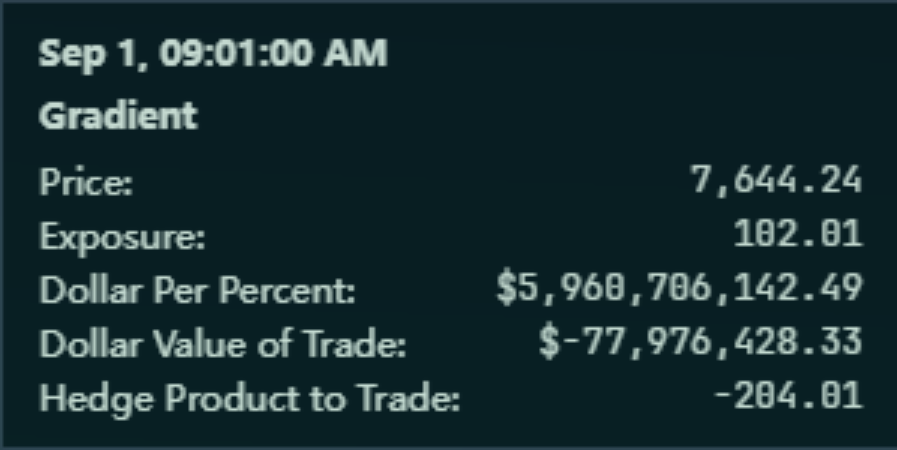
Each case starts from the position as it stood that morning, names the level that mattered and the decision made against it, then follows how the session played out, including the times it didn't work and how I handled them. New cases are added regularly.
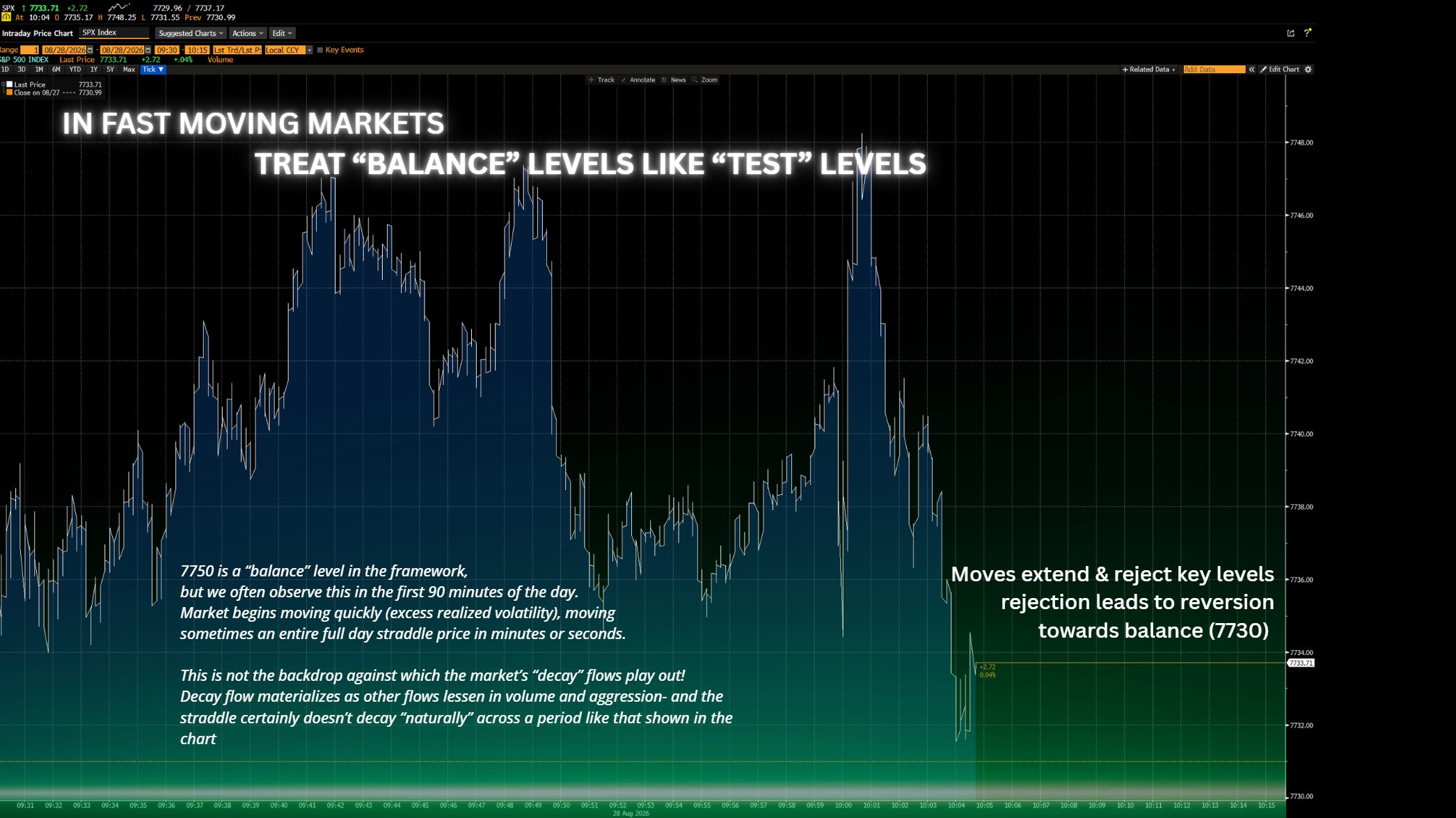
Messages from the VolSignals Discord: a member stuck on a problem, then one who got past it.
naive gex i find is very different on different gex providers
I came into VS with no formal finance background and a long track record of frustration trying to follow naive options order-flow services. After stumbling across VS, it genuinely felt like someone finally turned the lights on.
i have been chopped up relentlessly being in this negative gamma env expecting RV and getting crushed
Before joining Vol Signals, i would just look at a cluster of short strikes and naively assume we break down. These live sesions have complety changed the way i look at the markets now.
I don’t wanna just keep shorting and longing someone else key levels
I wanna learn why that level exist and the behavior of the market
[...] you aren't just saying a possible trade you are actually explaining it. So many times its just a statement on get this fly or that spread and not actually the thinking behind it.
The replies describe VolSignals teaching in general, not only this course. Individual experiences vary.
Markets are becoming more and more mechanical. Volume keeps moving from the underlying into options, and every option that trades puts demand on the systems market makers use to hedge. Seeing those flows ahead of time now matters whether you day trade or invest.
I learned this by trial and error. As a market maker your head is buried in your own position. Around 2013 one customer kept buying 5,000 to 10,000 weekly call flies and put flies. We sold them the blocks, and day after day the market halted exactly where we were longest gamma, then came unstuck the moment the customer unwound. It took us almost a year to see it for what it was.
What was happening then is exactly what we observe now. There is a system paired with these positions that has to buy or sell futures according to what they are, and everyone holding the same position is doing the same thing. I saw it again in 2018, when the index got too concentrated in strategies thought to be safe, like iron condors, and zero-day trading has since pushed delta hedging into machines. That is not reversing.
There's also a lot of bad data sold by people who never worked in the industry. Without correct positions and an accurate understanding of how it works, you might as well flip coins.

I'll be candid: one mistake people make all the time is trying to be precise. A general sense of how big the influence is and which way it points is enough, and that's something you learn to see on a chart without doing the math yourself. My focus is on simplifying a sea of greeks into something you can observe and act on from day to day.
The course is recorded, so it fits around a day job. You can watch all the videos in one night or take a month. It's up to you. Account size doesn't change the read either, because the boundaries and the balance point are the same whether you trade one contract or a hundred.
I have 0 clue about maths, but, as the days of education go on.. much more confidence daily. "How the fk are we going down STILL"...now I get it. (Same for upside)
[...] I'm not a professional trader. I'm a firefighter managing my own retirement account and this has genuinely changed how I think about risk and timing. [...]
I come from a completely different background (golf professional), but after 12 months with VS Pro, I can confidently say I know what I'm doing now [...]
People who trade SPX options or index futures and want to understand how dealer positioning can influence price.
Anyone using gamma levels or GEX tools who wants to understand the mechanics behind the numbers.
Anyone with a day job who wants a plan of their own before the open.
I spent 15 years at Belvedere Trading leading the index desk as a capital partner. I built the firm's training program, oversaw the tech teams responsible for hedging and automated execution, and traded SPX on the floor, upstairs over the phones and on screens.
The first group goes through the course with me. The modules are released in order over the launch week, and on the Friday I hold a one-hour live Q&A for everyone in the group. The modules are recorded, so you keep them for life, and the Q&A is recorded and added to the course the same evening.
Private Zoom for the group. Bring the questions from the modules or from the sessions you traded that week. The link lives inside the course page.
Start with the foundation modules now, free. Buy the full course when the teaching fits.
Start the free modulesIf you join after launch week you get every module and the Q&A recording.
Introduction and Delta are free. The full course opens with the launch week, and I take questions live for an hour on the Friday.
First, how market makers hedge an option. Then real positions, read by strike, so you can see how that hedging is likely to show up in a live session. Then your own trades, fitted to it.
Enrollment is open
How the course works
From first principles to trading strategies, each section builds on the one before it.
The course runs in three parts. First the principles: how a market maker hedges one option, and how that hedge changes with price, time and volatility. Then real positions, read by strike, and how the hedging flow is likely to show up on an actual day in a live market. Then your trading: adapting what the position says to your own strategies, responsibly, rather than to a forecast.
Today's range boundaries and where price is likely to settle.
If a boundary breaks, reset into the new range the same way.
Entries and exits from vanna and how volatility tracks SPX.
Notice when the edge behind a trade is no longer there.
Start with Introduction and Delta to get a feel for the teaching. Everything after them builds on those first principles.
Understanding gamma
Before you use a gamma level, understand how the position was built and what hedging it implies. These three distinctions are the foundation.
Naive GEX assumes market makers own the calls and are short the puts. Customers can buy calls and sell puts too.
Reverse the position and you reverse the implied hedge.
A trade near the ask doesn't establish that a customer bought it from a market maker.
Know who holds the position before modeling the hedge.
Short-gamma hedging means buying as price rises and selling as it falls. That can reinforce a move in either direction.
The gamma sign alone doesn't tell you which direction comes next.
Assess the position, understand the hedge, and judge what the resulting flow can and cannot tell you.
From first principles to trading strategies, each section builds on the one before it. Introduction and Delta are free. Then work through individual options, spreads and larger positions before applying the mechanics to a trade.
One option, its exposure and the hedge against it.
How options hedging can inform your market analysis, and what this framework can and cannot tell you.
Start with one option, calculate its initial hedge, and work out the next adjustment.
See how price, time and implied volatility each change delta and the hedge required against it.
Work through the adjustments from the market maker's perspective.
Take an option position, change the conditions, and calculate what you need to buy or sell.
Compare long and short options above and below the market, and the hedge adjustments each requires.
Study the hedge response near a long strike and the conditions that can support balance.
Build from individual options to the full position.
Combine individual options and add their signed exposures and required hedge adjustments.
See how neighboring positions reinforce or offset each other, and why the shape matters.
Connect the position and modeled hedge flows to tests, balance and conditional price behavior.
Connect the position read to instrument choice, price and risk.
Organize the position, expiry, price and time before evaluating a trade.
Read the hedge response to price movement without treating gamma as a directional forecast.
Work through time-related hedge adjustments and how their direction changes across scenarios.
Use session context and the observed price response to evaluate a path, then compare futures, outright options, spreads and butterflies.
Consider uncertainty, entry price, payout and the path while a trade is open.
Put the position read, instrument choice and risk management together in a worked example.
Extend the same process to implied-volatility changes, different expiries and longer horizons.
Planned as a separate part of the course, applying the same process to verified historical sessions. The core lessons use hypothetical examples to explain the mechanics.
Markets are becoming more and more mechanical. Volume keeps moving from the underlying into options, and every option that trades puts demand on the systems market makers use to hedge. Seeing those flows ahead of time now matters whether you day trade or invest.
I learned this through experience. As a market maker your head is buried in your own position. Around 2013 one customer kept buying 5,000 to 10,000 weekly call flies and put flies. We sold them the blocks, and day after day the market halted exactly where we were longest gamma, then came unstuck the moment the customer unwound. After a few iterations, it became obvious that our own collective hedging was working strongly in the customer's favor.
What was happening then is exactly what we observe now. There is a system paired with these positions that has to buy or sell futures according to what they are, and everyone holding the same position is doing the same thing. I saw it again in 2018, when the index got too concentrated in strategies thought to be safe, like iron condors, and zero-day trading has since pushed delta hedging into machines. Far from reversing, today's markets are moving faster, trading higher volumes, and demanding increasingly systematic hedging systems to facilitate all of the flow and risk transfer.
There's also a lot of bad data. It's sold by people who never worked in the industry. Without correct positions and an accurate understanding of how it works, you might as well flip coins.
I'll be candid: one mistake people make all the time is trying to be precise. A general sense of how big the influence is and which way it points is enough, and that's something you learn to see on a chart without doing the math yourself. My focus is on simplifying a sea of greeks into something you can observe and act on from day to day.
The course is recorded, so it fits around a day job. You can watch all the videos in one night or take a month. It's up to you.
Account size doesn't change the read either, because the boundaries and the balance point are the same whether you trade one contract or a hundred.
People who trade SPX options or index futures and want to understand how dealer positioning can influence price.
Anyone using gamma levels or GEX tools who wants to understand the mechanics behind the numbers.
Anyone with a day job who wants a plan of their own before the open.
I spent 15 years at Belvedere Trading leading the index desk as a capital partner. I built the firm's training program, oversaw tech teams responsible for hedging, execution, and user interface (UX), and traded SPX on the floor, upstairs over the phones and on screens.
Enrollment is open
Start with Introduction and Delta for free. Purchase the full course when you are ready, using the same account.
$797 one-time payment
Full course access. One-time payment.
Sign in or create your account in the course dashboard. Choose full course access there to complete your purchase.
Digital product. All sales are final. Watch the free lessons before purchasing.
It works, but it isn't a be-all end-all solution to your trading career. It equips you like a navigator with a map, and it's just a much better map than you're used to. I can give the exact same course and the exact same data to three different people and each one will trade it differently. Sharing it doesn't reduce its efficacy.
No. Introduction and the Delta module start from one trade and one hedge, and everything after that builds on those two.
No. The course teaches you to read the position and set the day's boundaries. What you trade against those levels, whether futures, options or spreads, and in what size, is fitted to your own account, margin and schedule, and the Trading module goes through how to choose.
The lessons are recorded. You can watch it at a time that suits you and revisit it whenever you need.
No. The examples are shown inside the modules. A VS3D subscription lets you read the same position live, and it is not required.
Introduction and Delta are free with a member account. When you are ready, purchase full course access from the same course dashboard. Premium lessons become available according to the release schedule.
Watch Introduction and Delta for free, or purchase full course access.
Our latest analysis of market maker positions and hedging flows, delivered to your inbox.