There's a betting strategy so seductive, so mathematically elegant, that it's been bankrupting gamblers for three hundred years.
It's called the Martingale.
And it works like this: you make a bet.
If you lose, you double it.
Lose again?
Double it again.
You keep doubling until you win... and when you finally do, you walk away up one single bet.
The math checks out.
With infinite capital, the strategy is literally unbeatable.
In the real world, however, nobody has infinite capital.
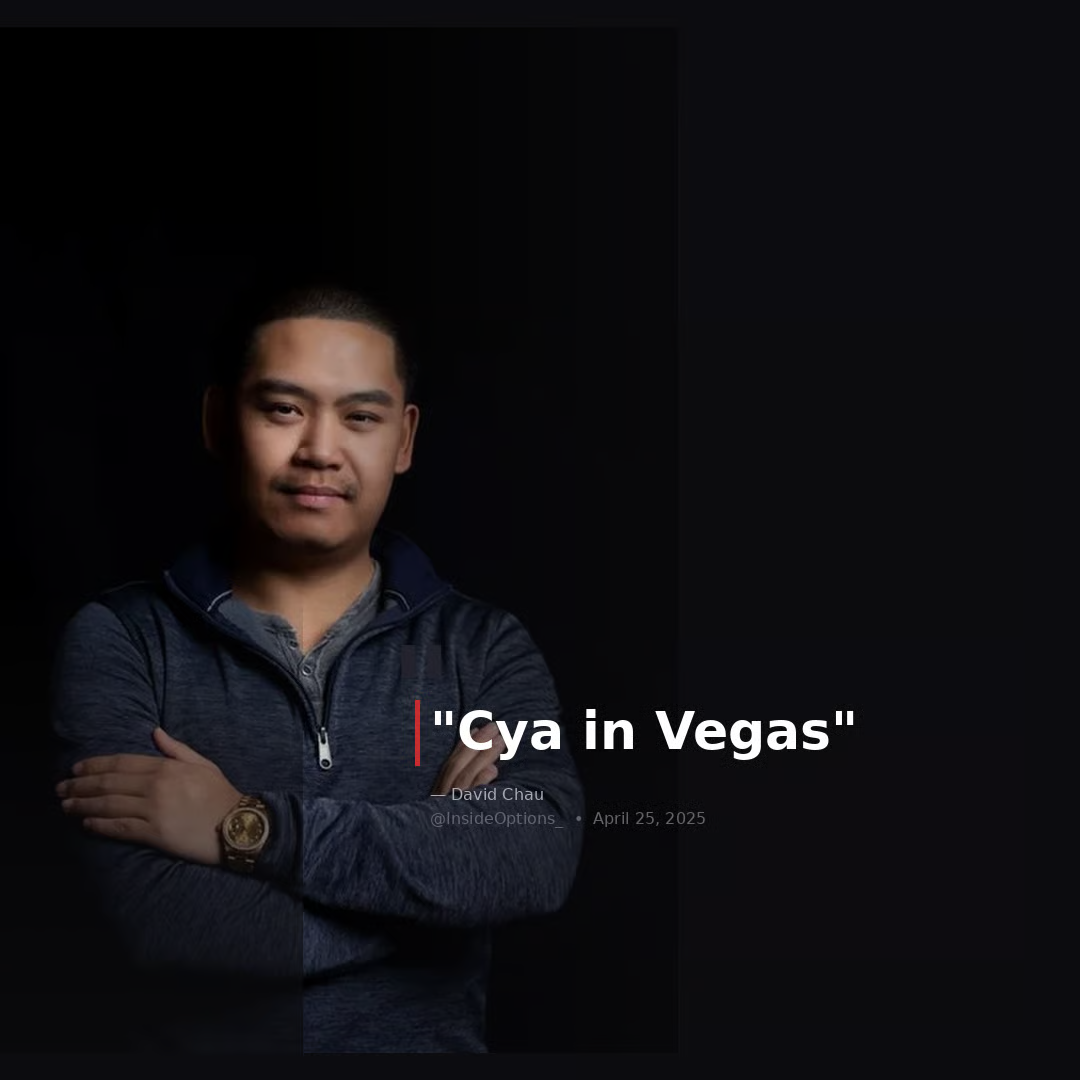
David Chau thought he found a way around this.
A 5-point wide iron condor on the SPX is about as "safe" as option selling gets.
You sell a put spread below the market and a call spread above it- both spreads are out of the money when opened.
If the index stays between your strikes at expiration, you keep the premium.
If it doesn't, your maximum loss is defined: $5 per contract, minus whatever credit you collected.
No unlimited downside, no spiraling margin calls...
- just a clean proposition:
Market inside condor = win
Market outside condor = loss
It's this "defined-risk" which allowed Chau to adapt the structure to the Martingale strategy.
David's system worked like this:
Every day after the 4:00 PM index close, sell a 1DTE iron condor with short strikes around 16 delta, roughly one standard deviation away from the at-the-money.
Collect your $1.50 to $2.00 in premium.
The next day, if the market stays inside your range... you keep it all.
If the market closes outside your strikes... you lose.
This is called a "breach" - your loss is maxed out at $5 minus the premium you collected.
A traditional martingale strategy involves doubling your bet after every loss, in order to eventually make back your bet.
But the iron condors here were asymmetric propositions.
Risk $3 to win $2 is NOT an even money game.
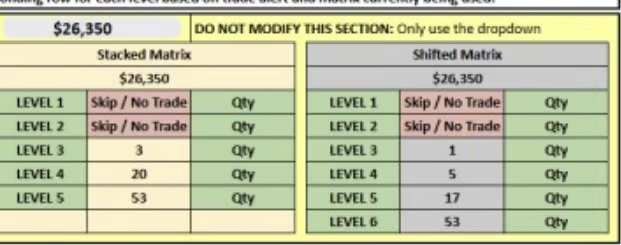
After accounting for both the costs of trading, and the tendency to capture premiums just shy of $2, the strategy requires something closer to a "triple down" than a double down in order to net +1 bet at the end of the series.
The examples below have been shared in the public domain and attributed to David's program.
—I've confirmed them with members of his group.

If markets were distributed normally enough for the laws of probability to have a seat at the table, then the math suggests a blowout event should happen roughly 1% of the time.
It works like this:
The probability of the market settling outside +/- 1 SD in either direction is approximately 31.73%.
Assuming there's no serial autocorrelation (each day's price is independent of the last), then the probability of two losses in a row is 31.73%², or 10.07%.
For three sequential losses, the odds drop to 3.19% -
...and a blowout event—four losses in a row—should only happen 1 in every 100 trade series.
This series is not meant for debating the quantitative merits of the Martingale, or of David's various sizing matrices — the latter deserves its own full treatise.
Instead—
I'm going to walk you through the entire final series, trade-by-trade,
through the eyes of a market maker >>
Everything you're about to see has been verified at the source.
The raw data comes directly from the Cboe.
"We know where the bodies are buried."
Before we start- know that I find no great pleasure in this.
I never understood people who cheered on the failure of others at large, especially in my context.
Setting aside the moral angles... whether running the game or playing it, you never want to see customers disappear.
If you're running the game, you want the volume.
If you're playing it, you should be thrilled to have large rules-based flow with tradable footprints.
I warned about this moment, one year ago today >>
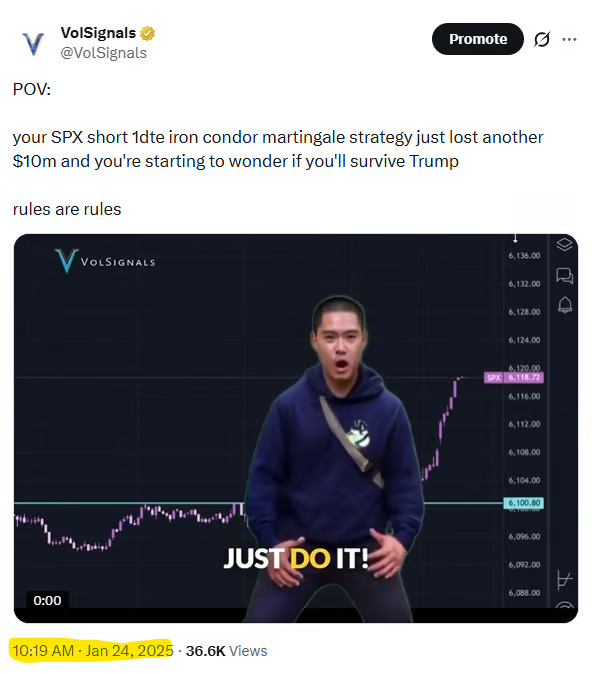
I didn't do this for engagement— really.
I had basic ideas for how to make their program safer, and I wanted to get on David's radar to speak to his team.
I could already see where David's marketing style would lead.
What he was doing looked fun—but it would create unrealistic expectations for the longevity—and compoundability—of his system, in the eyes of his client base.
As he survived near-death experiences, I worried that the sense of immortality would create an ego destined to make a mortal out of him in the end.
Unfortunately for David and thousands of his followers, my predictions- and the paths through which I imagined they'd unfold- turned out to be correct.
The story is full of lessons— right down to the final trade.
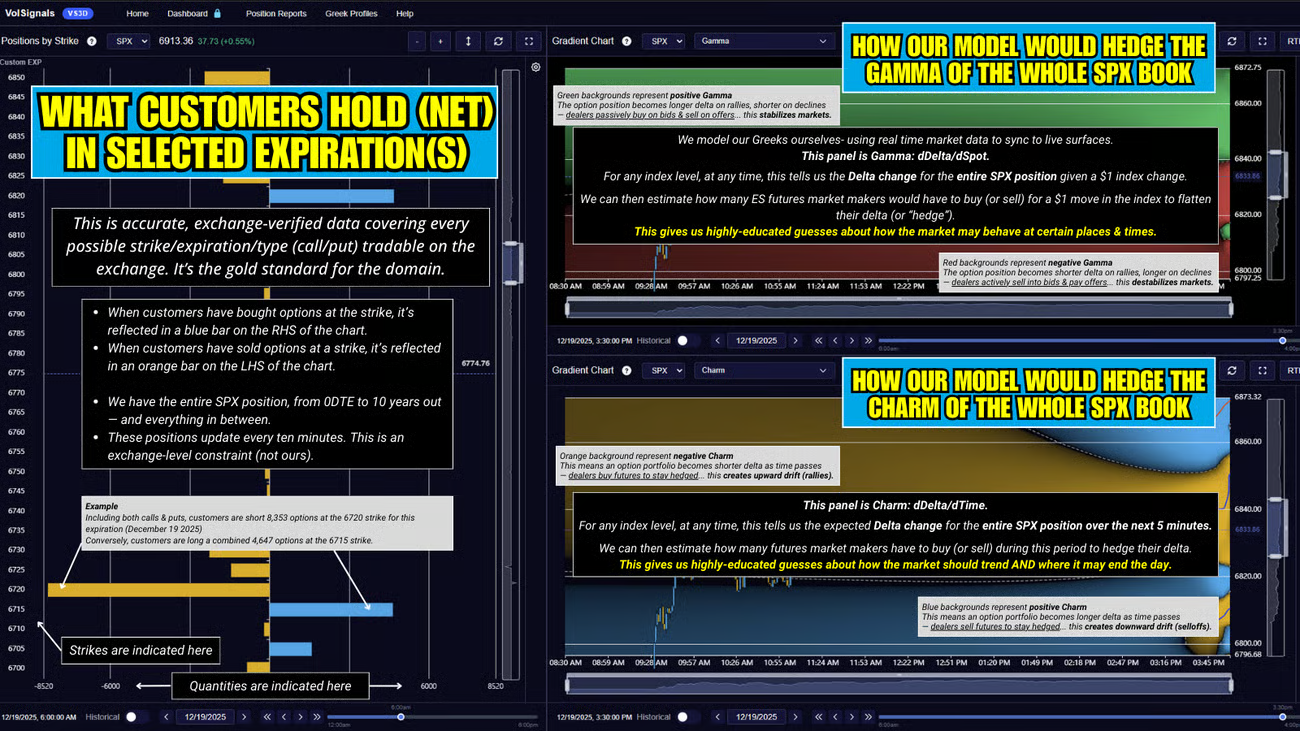
Consider this your map to the market.
The image above is your key— your basic legend for the dashboard view which I'll use to walk you through the final series of trades.
VS3D™ by VolSignals™ is our proprietary platform—custom-built to convert raw exchange data into actionable positioning intelligence. It's available to anyone, but its architecture is entirely institutional. Our engineers built and ran the tech stacks behind market making operations at best-in-class firms.
Matt managed volatility on the index desks of some of the largest banks in New York.
I spent my career as partner and lead trader/ co-manager of a fast-moving, dynamic index book at one of the biggest Chicago market makers on the Cboe.
VS3D™ goes beyond the visibility we had as institutional market makers.
It gives a full picture of what's going on under the surface in the SPX.
For every tradable SPX option, we know if customers are long or short—and how many.
This matters—tremendously.
We managed the other side of this book, ourselves.
We know how the hedging models work— where they need to be adjusted, and how real desks adapt to constraints.
We know which positions move markets, and how to find what large managers attempt to hide.
We know where the bodies are buried.
At times, this context gives us tremendous edge in our own trading and analysis.
VS3D™ Starts with a Question:
"If I were the single SPX market maker—responsible for hedging the entire customer book—what would my model be doing right now?"
Our answer is a robust, configurable simulation delivered through a "buttery smooth" interface (per client feedback).
Every day, in real time—and historically—our platform answers the questions that matter:
This is how we see the market.
And it's exactly how we're going to walk through David's final series.
...it's the best view in the house for events like this.
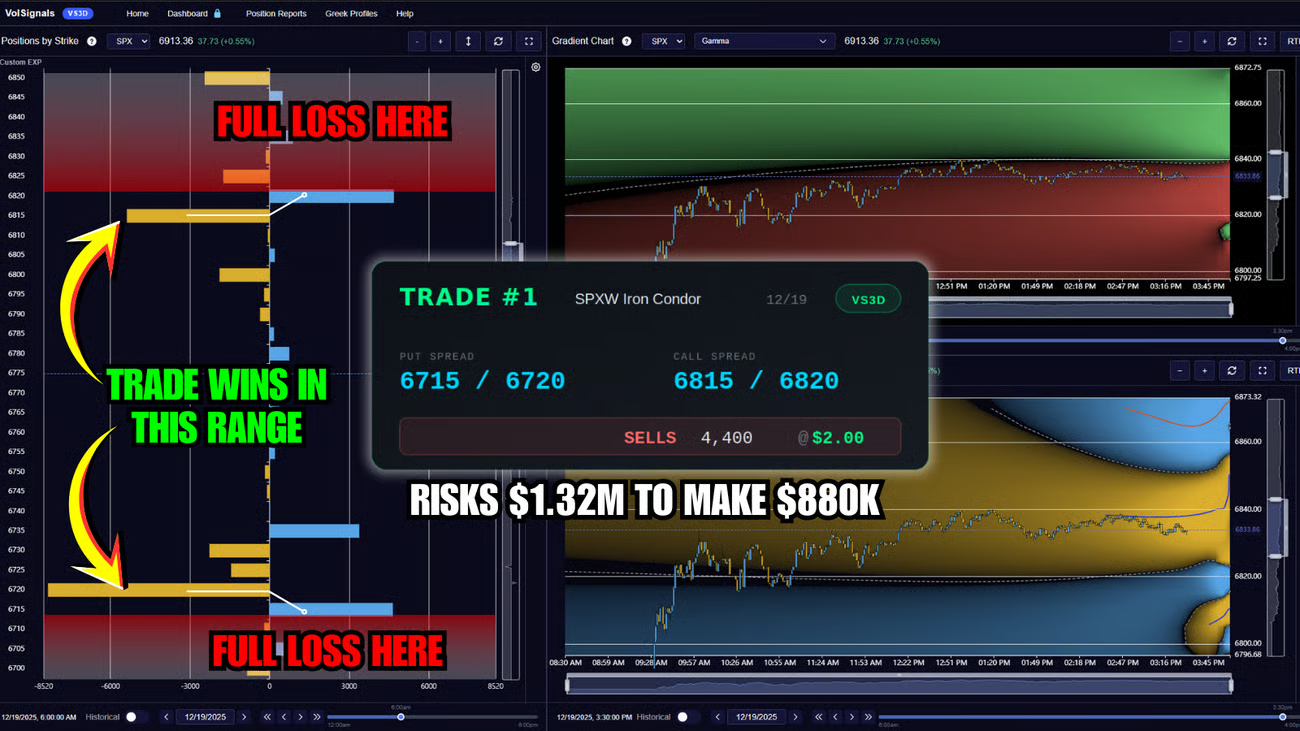
12/19 SPXW 6715 / 6720 // 6815 / 6820 Iron Condor
SELL 4,400x @ $2.00
The first trade was placed after the close on December 18th, 2025 between 4pm and 4:30pm ET.
The image above shows the trade itself.
Group collects $2.00
...they're risking $3.00 (before cost) to win $2.00
At this size, the group risks $1.32M to win $880k (1.5 loss-to-win payout ratio)
...including a .10/spread cost allocation (modest here), the group pays $44,000 in total for the trade
Effectively, the group is risking $1.364M to win $836k.
FULL WIN = 95 point range (6720 — 6815)
BREAKEVENS = 6718 / 6817
FULL LOSS = close below 6715 OR above 6820
This... looked like a great proposition for an iron condor.
However—
12/19 2025 was the largest expiration of the year.
Large expirations like this often resolve mechanical hedging processes, shifting the character of the price action once the settlement is behind us.
To the uninitiated, the behavior thereafter frequently comes as a complete surprise.
I carefully articulated my view, directly on my public feed even as markets continued to test me.
Sure enough, "OPEX marked the spot," and the SPX turned sharply higher that same day.
David and his followers took a full loss.
I saw the group placing Monday's trade, and my heart sank.
I knew then and there, it was the condor's last flight.
...you'll understand how I knew it too in just a few minutes >>
Preview: I walked through what may happen to deliver the cinematic finale after that close >>
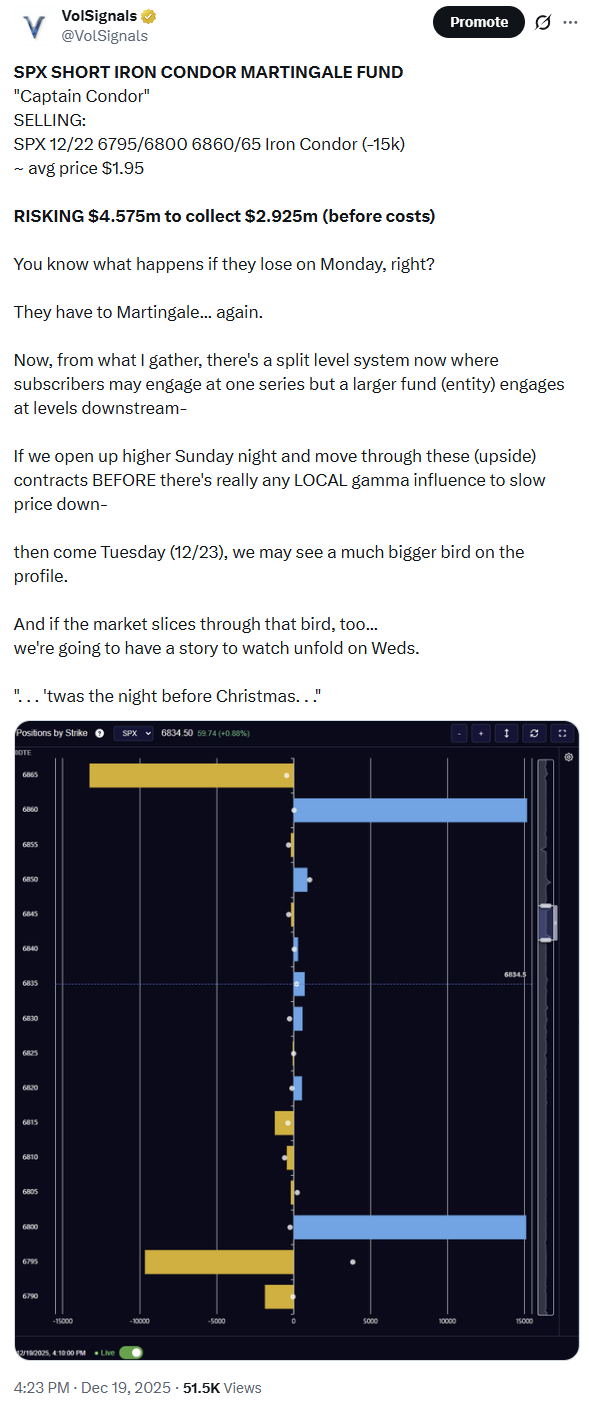
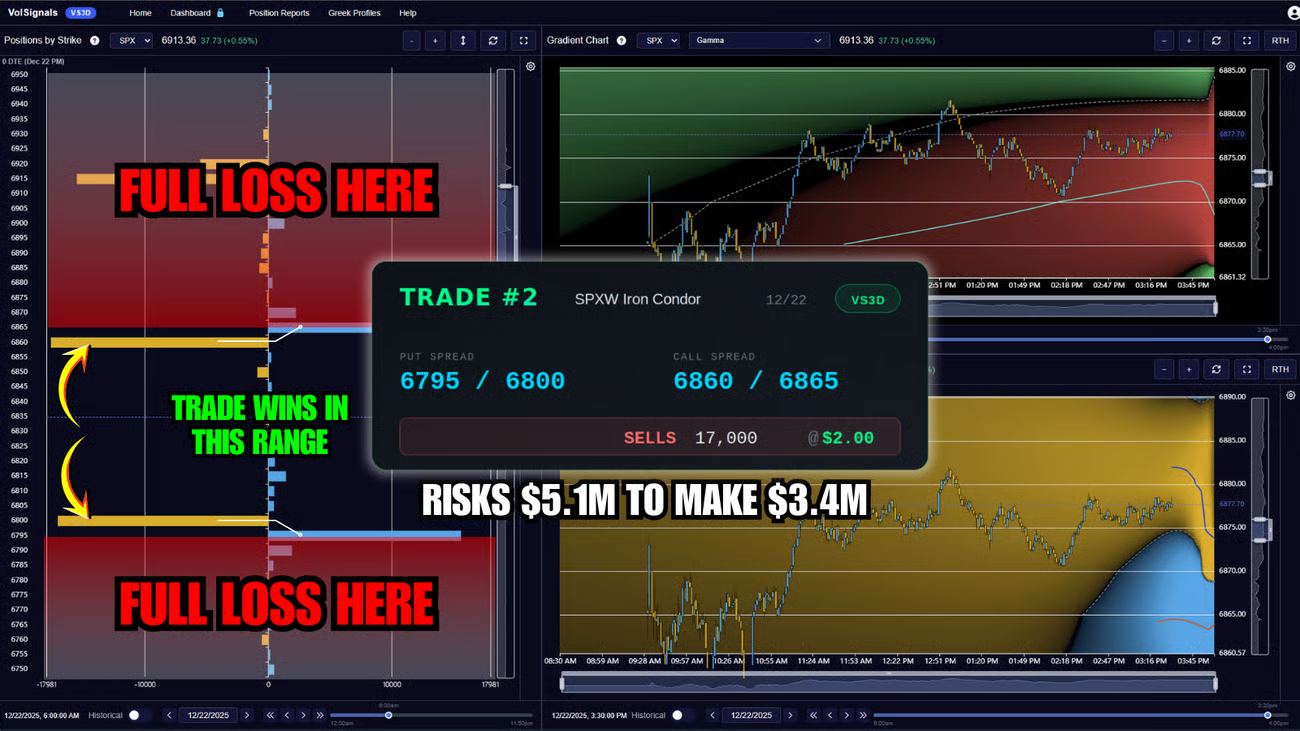
12/22 SPXW 6795 / 6800 // 6860 / 6865
SELL 17,000 @ $2.00
The second trade was placed after the close on December 19th, 2025 between 4pm and 4:30pm ET. The trades happen during this window, because the strike selection process which David employs is not generated with historical data, per se— it's derived from the very pricing of the following day's option chain.
This becomes increasingly critical as the series progresses— David leading the group through an increasingly illiquid and abnormal period of the year, when it comes to market behavior.
The very pressures I anticipated given the colliding forces of mechanical hedging pressure, liquidity (or lack thereof), seasonal exuberance, and more— kept knocking in.
The index would slice through the group's call spread with ease, settling at 6878.49, just ~12 points shy of the benchmark's record, set earlier in October when the signs were there.
David and his followers took (another) full loss.
Before we carry on... do you remember how the Martingale works?
You have to continue betting enough to win back your prior losses (and costs in this case).
Until now, trades risked $3.00 to win $2.00
Keep those thoughts in mind.
We're going to drill down into the numbers at the end, to show you just how far off the rails this "strategy" went.
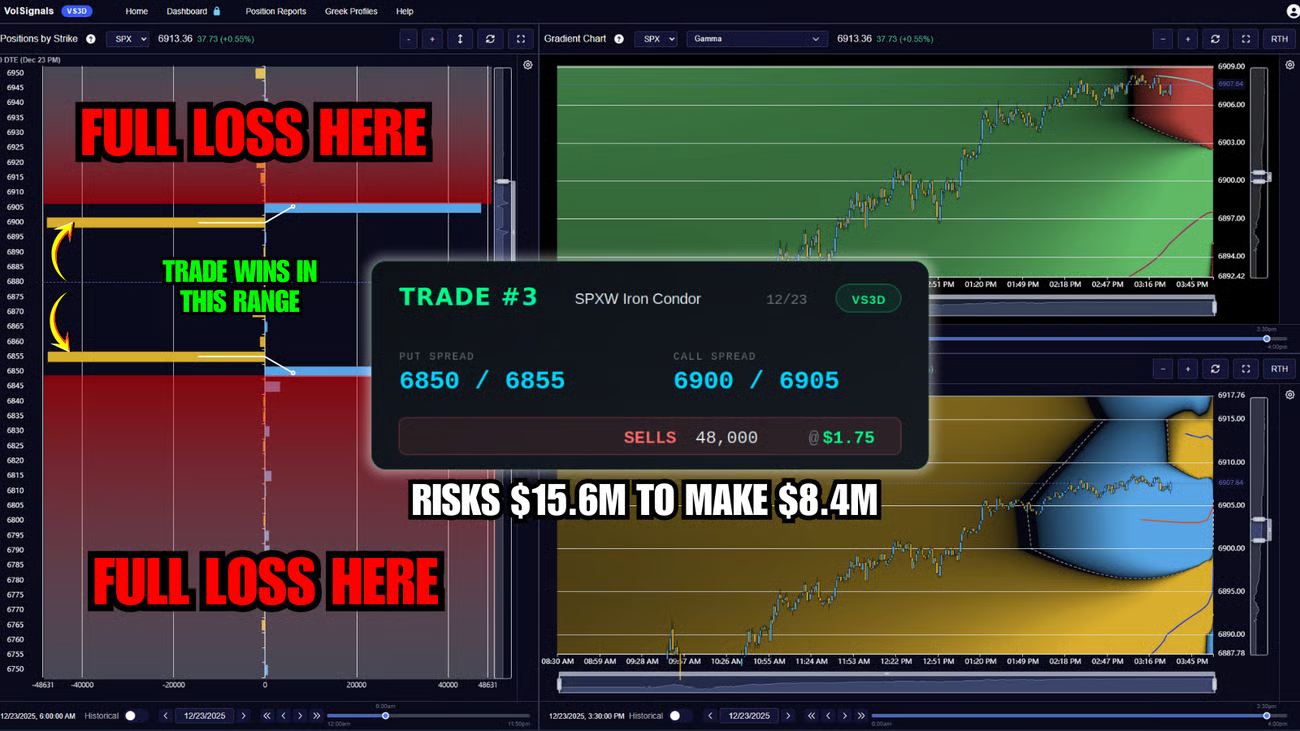
12/23 SPXW 6850 / 6855 // 6900 / 6905
SELL 48,000 @ $1.75
This third trade was large by any measure.
Against any other market backdrop, you might expect a trade this large to be somewhat of a self-fulfilling prophecy for the seller (in a good way).
Concentrated positions create predictable hedging flows.
The buying and selling required throughout the day to manage these positions is modeled, simulated and presented visually for you right there in VS3D™ by VolSignals™ — the only dealer hedging flows platform built by actual market makers. (this will remain my favorite thing to say, for every second it remains true ;).
But markets aren't purely efficient, statistical machines.
There are real constraints, real limits impacting this machine's function.
Most of the time, sellers have to sell lower to find a clearing price.
Notice how David & his group willingly accepted lower and lower margins of error (45 points of safety in the third trade, vs the 95-point wide "full win" range of the first trade).
This is however completely fine.
The strategy is derived from market prices.
As options cheapen— we love to give you Christmas sales as market makers— so too does the 1-standard deviation range underpinning Captain Condor's Martingale strategy.
David's forced error was the bet pricing.
The Martingale sizing matrix has some margin of error at the lower levels. You can see plainly that once any trade wins, the group would win back more than just their first bet, after accounting for all cumulative losses & trading costs.
The strategy is arithmetically anchored to a win / loss ratio.
If the boundaries of that ratio are broken— if you accept too poor a bet...
then your Martingale won't work— EVEN WHEN IT WORKS.
The group, led by David, would continue the series by selling larger and larger size at smaller and smaller prices.
Was the math drunk on eggnog?
I'll spell it out for you with the next trade — let's go >>
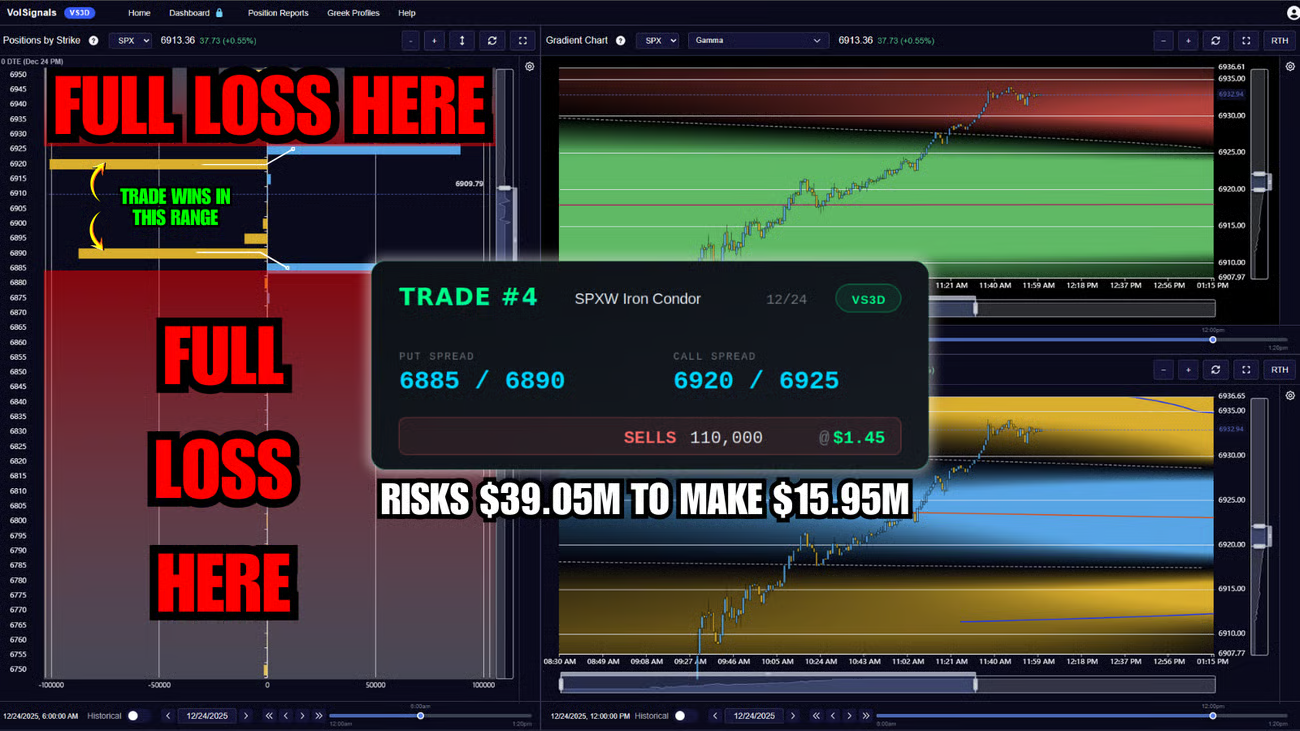
THE FINAL FLIGHT
12/24 SPXW 6885 / 6890 // 6920 / 6925
SELL 110,000 @ $1.45*
Someone at InsideOptions must have realized the mistake.
Whether they realized how dangerous of a spot they were already in, I can't say.
But someone must have realized they didn't sell enough to make sure a win would cover the cumulative losses and costs accrued.
Notice the asterisk up there in the trade log.
On Tuesday's close, the group sold just 100k iron condors.
I watched it live on my X stream with my followers. (click for the replay)
To be sure— the size was an absolute ton.
But that size wasn't enough.
The condor couldn't be saved.
Overnight, our data captured the frantic "catching-up" of the series, to deploy more volume to recoup more premium.
This was a Catch-22, a forced error after violating the bet-ratio constraints of the strategy.
Selling $1.45's was already fatal.
Watching someone spend hours overnight, finally selling another 10,000 down to $1.35?
Pity.
Compassion.
You can't help but root for the underdog sometimes,
even when the underdog properly deserves it.
As hard as David made this— by letting his ego run his socials—
it would cost thousands of people, not just David.
Thousands of people less able to understand—or tolerate—the extinction of their life savings.
Their "sure thing" was never as sure as David portrayed.
And that's why I decided to write this series.
— and since you wouldn't be here reading it, if not for the cinematic blowup at the end, I'll spare you the drama.
On Christmas Eve, the SPX rallied 0.32%.
Thirty-two basis points was all it took for the Martingale to make a dodo out of the condor.
If you watched my X stream, read any of the media coverage, or watched my Youtube explainer - you may have wondered (like David?) what it means that "firms held 60k of David's iron condors"
Sounds scandalous.
Your mind may have already wandered off in unintended directions.
...David's did.
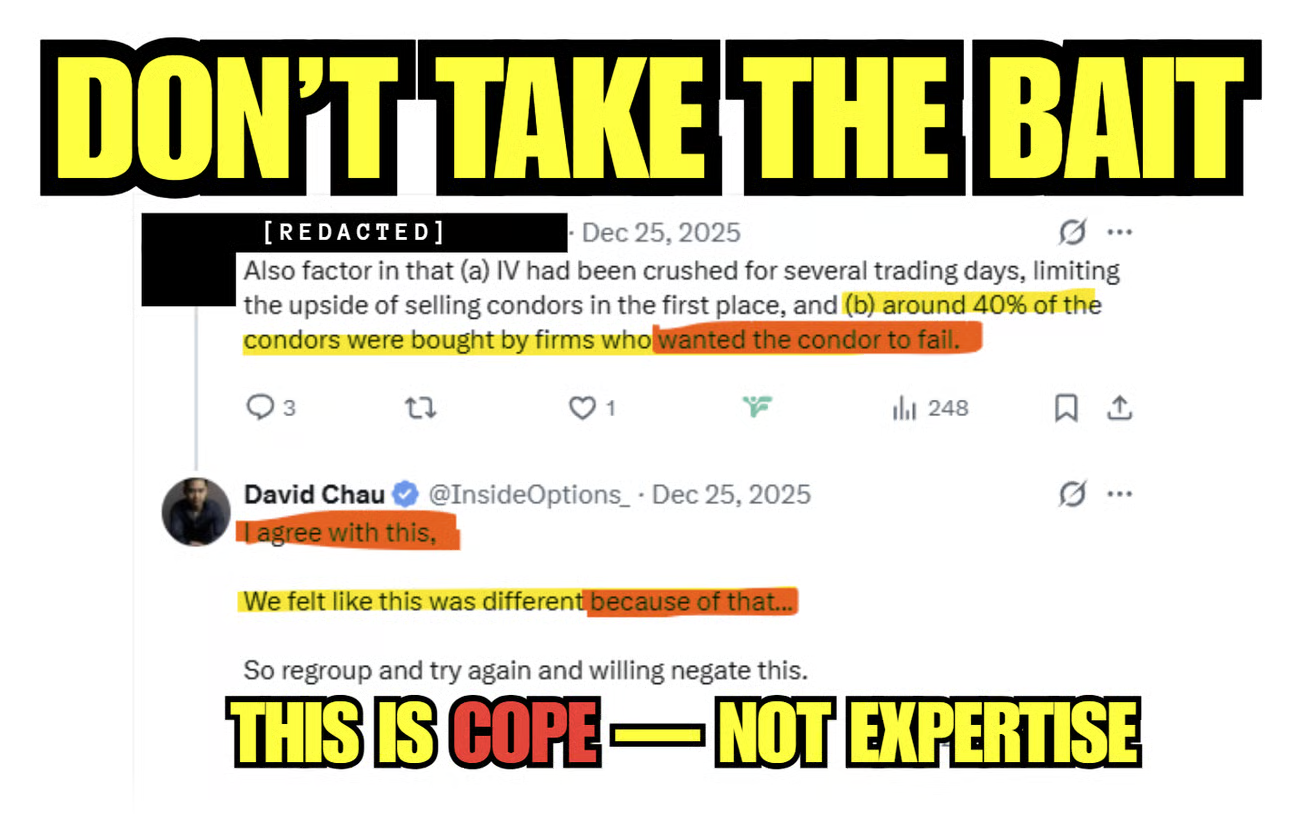
Don't take the bait.
When push comes to shove, and flows cluster in predictable ways big enough to cause persistent pain for those managing them— markets tend to solve these problems (in favor of the market maker).
Let me be crystal clear—
These outcomes— when the customer finally gets pinched— are not the product of collusion, nor of any sort of calculated intent to manipulate the market.
They often happen downstream of specific adjustment to an outlier, and often that calibration means (for better or worse) that the hedging flows are more discretionary, more discrete.
These are consequences of pragmatism, not conspiracies of predation.
It's this— and everything like it— that made me start VolSignals in the first place.
Hell or high-water (or both, living in the Keys)... something inside me calls on me to correct the record.
If this work helps you, if it's meaningful to you in any way... great!
(please share it far and wide)
I didn't partner with institutional software engineers to launch my own platform, bring on a senior vol manager from UBS and a partner with hedge fund experience so that I can do less of it!
Buckle up, we're just getting started.
—hope you come along for the ride
Hear what the VolSignals community is saying.
Testimonials reflect individual members' experiences and are not typical results or a guarantee of future performance. VolSignals provides educational content only, not investment advice. Trading options and futures involves substantial risk of loss.
Made by craze&friends. © 2026 Volsignals. All rights reserved.