
Absolute nonsense.
The seeds of spurious narratives are planted daily, all around you.
Often times the common fallacies are dressed in hyperbole and coming from accounts you know by default to dismiss as tourists or soured gamblers.
We know very well to filter out the noise from the ZeroHedge comments section.
But what happens when the seeds are planted by those you view authoritatively?
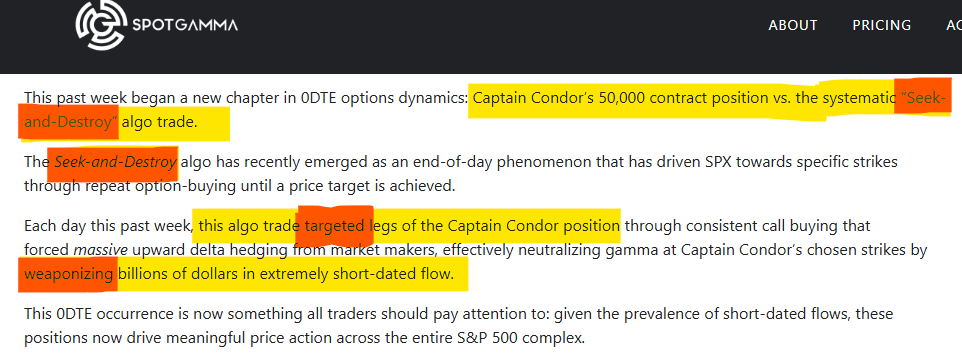
On September 7th, 2025 Brent Kochuba of SpotGamma penned the following:
Say what you want about market makers— the truth is we are all held to strict standards.
Half the things you assume to be "business as usual" are enough to get you U5'ed (terminated), automatically.
I remember once buying futures when I had to sell them.
We call that a "Texas Hedge."
Honest mistake, easy enough to correct (albeit costly & stressful).
Minutes later... a message from compliance:
"Please reply to document the series of trades in assets [...] between times [...]"
This was an internal standard- it seemed a bit silly to me at the time.
But you know what's expensive?
Regulatory inquiries.
There's no "boogey-man" out there conspiring to take out your stops.
Liquidity providers capture a small fraction of your bid-ask for the honor of taking the other side of your trade.
We don't really care if you win or lose, if we're managing our book well.
In fact, we can both win- because we're hedging (you probably aren't).
The value of the trade in our book to us, when all is said and done, goes beyond the settlement PNL and includes things like "gamma scalping" attribution, beyond the scope of this note.
We don't "want you to lose"
Sure, we're your counterparty— but this isn't zero-sum.
We aren't playing the same game.
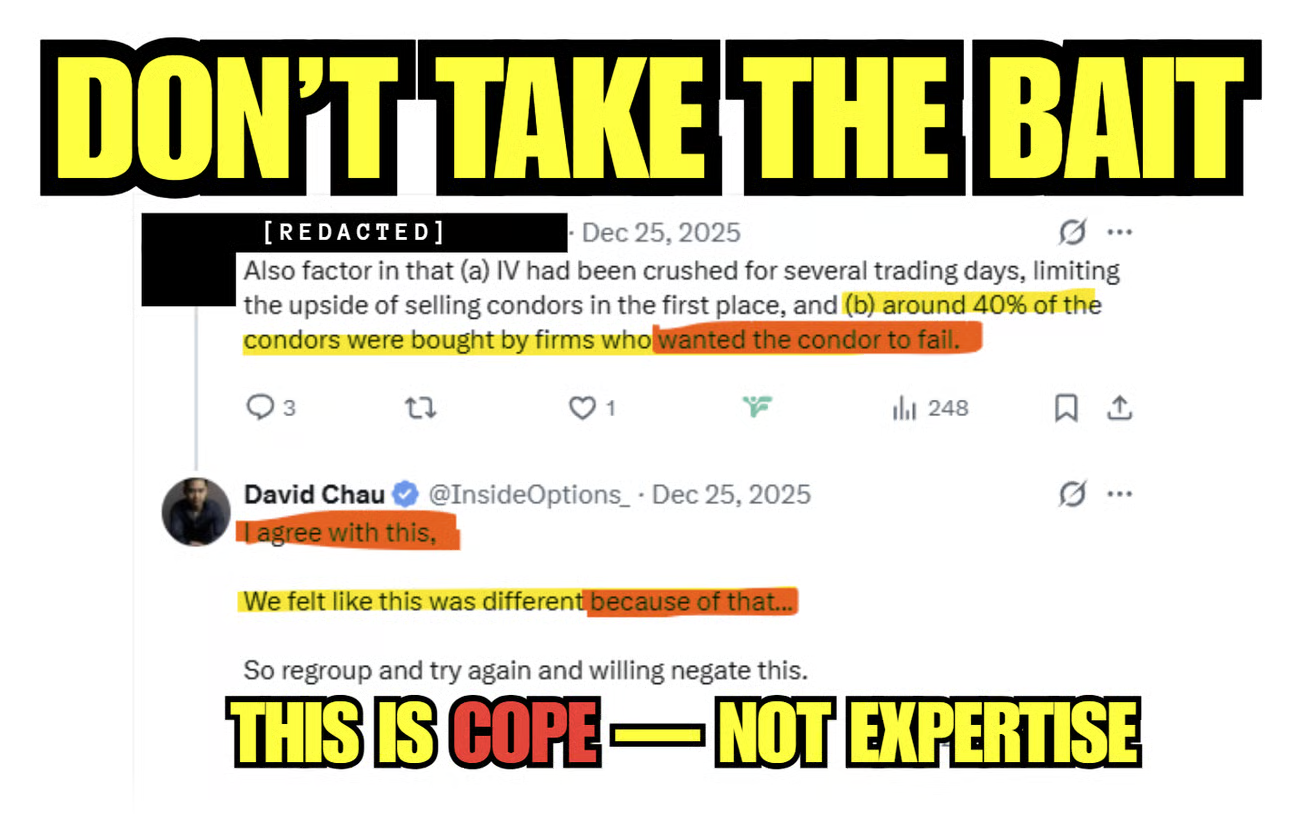
It's easy to buy into the lie.
It sounds logical— and it sells.
It pulls at that part of our brain that just wants to believe it's not our fault, that the game is rigged— that an omniscient foe is lurking around every corner, conspiring to rob us of the wins we deserve.
But it's a lie.
Even if you believe it- you know it's a lie.
If you really believed it, you'd have stopped playing long ago.
Sorry, you're cornered on this one.
The truth sets you free.
...but it's okay.
We've all made that mistake once or twice.
Successful traders course correct, because of one key thing.
You won't succeed as a trader with an external locus of control.
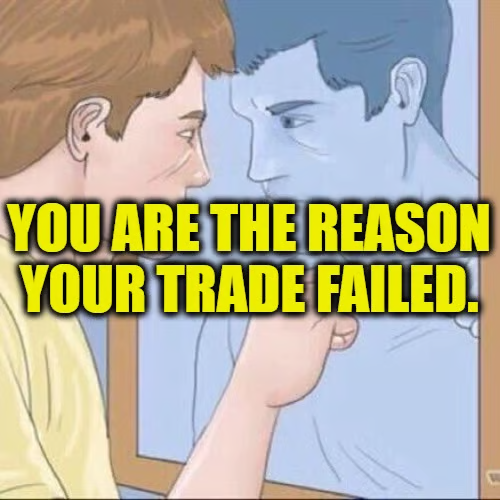
Start with a trade that's bad from the start.
First, let's define bad.
For the final Martingale series to succeed, the premium collected on the last trade would have to cover its losses and pay back one bet.
Basic.
On December 23rd, the cumulative losses from the trackable trades were approximately $22m.
Given the final trade size of ~110,000, to cover an entire $22m in losses PLUS one bet, the group would have to collect around $2.10 — maybe $2.20 after accounting for fees.
If your strategy requires that price to be compliant with its own logic, then selling below that price would be suboptimal— to put it lightly.
After all, what good is your fancy matrix, if you sell all 110k at 1.75, "win" your series with a good settlement, and still come up $3 or 4 million in the red for the series?
—that's not how a Martingale's supposed to work.
A "bad bet" is one which doesn't pay you enough when you win, to justify playing in the first place.
By this logic, the bet was bad.
there's just no escaping the math of the problem.
How bad was it?
In the prior writeup I highlighted the shortfall.
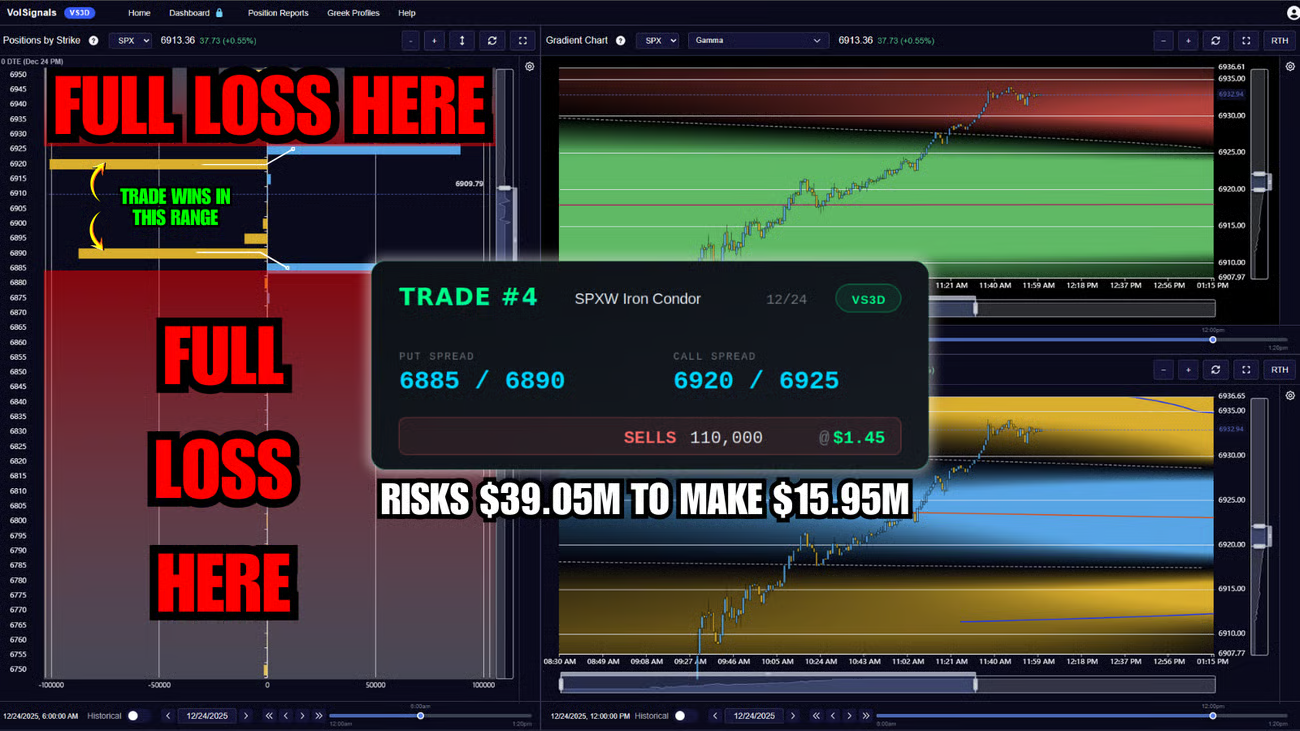
The SPXW 12/24/25 6885-6890 / 6920-6925 Iron Condor was sold at an average price of ~$1.45.
Even if your math is right on the ODDS of settling inside your structure, your bet is so mispriced that you have to get extraordinarily lucky— JUST TO HAVE A CHANCE TO FIX IT LATER.
Even a WIN would be a loss— because your series would still be DOWN over $7 million.
What does it mean if the final bet—
the one that's supposed to pay you back all of your losses PLUS ONE BET
Leaves you down 7 bets at the end of your series?
It can only mean one thing

No, Captain Condor wasn't "targeted."
There's no "Seek-and-Destroy" algo.
In fact, that hyperbole without verification would cost most registered professionals a license, in addition to their credibility.
"but even your data shows FIRMS on the other side."
You like firms?
Name all the firms.
(no, really)
Who are they?
What are their interests?
Are they market makers? Broker Dealers? Both?
I won't pretend to speak for everyone. But I was a partner at a firm in this business and did heavy index volume— and I don't mean tiny puts for numbers.
I routinely traded and helped manage very large positions. I enjoyed trading big enough to make the team uncomfortable when I thought the edge was right.
"this trade is so good we'd be fools not to take it all down"
So you're looking at this offer and by any measure you should buy it.
1.45 offer to a 1.65 theo and vol is already at the 0th percentile with the index at ATH into a low liquidity day.
How many do you buy?
Careful.
Think deeply here before you answer

Remember, you're a market maker.
At this price, you want to trade as many as you can.
But "as many as you can" is subject to constraints that are much like those a casino navigates.
After all, if you take on all 110k iron condors- you're not really a market maker tomorrow.
You're a prop desk— a hedge fund / whatever you want to call it, your market making business is suddenly a sideshow to the main event.
This is a problem.
Beyond a certain size, your desk isn't equipped to integrate into its business-as-usual.
You're not "targeting the customer"
The customer needs your bid to fill the order.
You're not "targeting the customer" when you make logical accommodations for the trade.
Maybe you need to house the trade in another account because you don't want this inventory to be hedged the same way.
I used to do this when I was making markets— not for any nefarious reason... I just wanted oversight on a particular trade which I knew was more "prop trade" than market making, within the context of our desk.
If we trade something that's important to hold against something downstream- I don't want to "accidentally trade out of it prematurely."
If we are too big on certain strikes, maybe I don't want my hedging model auto-calibrating the vol slide to the inventory if it's pushing the limits of what's logical for the model.
These are accommodations to enable managing the other side.
Because when the trade is too big, it's no longer a trade— it's a position.
And if your PNL is entirely down to positional performance- you're not market making, period.
No matter how you look at it
—nobody "targeted" the last condor, it was free money.
♪ ♫ ...it's the MOST . . . illiquid time OF THE YEAR... ♫ ♪
I planned to spend most of this email impressing you.
Originally, I was going to talk about when and where I'd seen strategies go wrong in the past.
200k Iron Condors wreaked havoc on holiday markets in 2018.
I was going to talk about the risk of outsizing your market.
You might get away with it for a while— but it's not a coincidence these problems come to a head when liquidity disappears.
I was going to talk about local gamma.
Vol paths. Distorted surfaces. Hedging constraints.
But the truth is — we don't even need to go there.
The buck stopped with the bettor,
—and his unbelievably. bad. bet.
Hear what the VolSignals community is saying.
Testimonials reflect individual members' experiences and are not typical results or a guarantee of future performance. VolSignals provides educational content only, not investment advice. Trading options and futures involves substantial risk of loss.
Made by craze&friends. © 2026 Volsignals. All rights reserved.