

Learn to interpret dealer positioning, build conditional market scenarios, and recognize when your initial read needs to change.
Create a free account to preview the teaching. The full course opens on [opening date].

I spent 15 years leading an SPX options desk as a market maker. This is how I teach members to read the market maker position and turn it into a daily map of SPX: where it's likely to top out, bottom out and settle.
Markets are becoming more and more mechanical. Volume keeps leaving the underlying and moving into options, and as option volume grows it puts greater and greater demand on the systems market makers use to hedge their positions. So now more than ever, understanding how these flows move markets, and seeing them ahead of time, matters whether you day trade or invest.
I learned this by trial and error. As a market maker your head is buried in your own position, and truthfully you don't know the entire market's position. Around 2013 there was a large customer who'd consistently buy 5,000 to 10,000 weekly call flies and put flies. Time after time we'd sell them large blocks, only to come into the next trading day stuck right on our long, with the market halting exactly where we were longest gamma. As soon as the customer unwound, the market would become unclenched. It took us almost a year to realize this was flow we should stay away from.
What was happening then is exactly what we observe now. There's an actual system paired with these positions that has to buy or sell futures according to what the positions are, and everyone holding the same position is doing the exact same thing. I saw it again in 2018, when positioning across the index became too concentrated in strategies conventionally thought to be safe, like iron condors. And as zero-day trading grew, delta hedging had to be systematized and offloaded into machines. That trend isn't reversing.
There's also a lot of misinformation out there, and a lot of bad data sold by people who never spent any time in the industry as professionals. Without correct positions and an accurate understanding of how the industry works, you might as well flip coins.
You've probably had a day like this. The gamma chart showed support, so you held, and SPX went through it without slowing down. Or the chart read short gamma, everyone said that means down, and the index closed higher anyway. That costs you the trade, and after enough of those days it costs you the confidence to take the next one. The reason is usually either the data underneath - or the interpretation. These are the three mistakes I see most.
It assumes market makers sell puts to customers and buy calls from them. If you've ever bought a call yourself, you've invalidated the entire model.
Whether an option traded closer to the bid or the ask doesn't tell you who holds it. What matters is which part of the open interest sits in the accounts that hedge.
Gamma is a liquidity condition. It describes how the market is likely to move, quickly or slowly, erratically or predictably, and it doesn't pick a direction.
That's why everything in the course is built on the correct positions.
You should be able to look at market maker positions, gamma profiles and charm profiles, understand exactly what they mean, and trade them yourself responsibly. On an intraday basis, you'll start each day with a map of SPX: the upside boundary of today's range, the downside boundary, and where price is most likely to settle in between. If a boundary breaks, you reset into the new range the same way. On wider timeframes, you'll use the vanna profile and how volatility and the index move together to set swing targets, entries and, just as importantly, exits and the criteria for when a trade isn't going well.
Each module builds on the one before it. Introduction and Gamma are free, so you can judge the teaching before you pay for anything. After the free Gamma module you'll be able to read a gamma profile and see why negative gamma doesn't mean down.
You'll be able to tell real positioning data from inferred data, whoever is selling it.
You'll be able to follow one trade from the fill to expiration and say what the hedge does at each step.
You'll be able to read a full position as the combination of trades it's built from.
You'll be able to read a gamma profile and say whether today is set up to be a fast market or a slow one.
You'll be able to say which way market makers have to trade as the day passes, with the index standing still.
You'll be able to set swing targets from the vanna profile and the way volatility and the index move together.
You'll be able to set the upside boundary, the downside boundary and the balance point for the day, and reset when one breaks.
You'll be able to take a real morning's position through to the close and see where the read held and where it didn't.
A single short option first: move spot and read the delta, the hedge quantity and the re-hedge trades. Then the same question on a real full-position snapshot: net gamma, the required ES hedge, and the flow a move implies. A scenario picker holds four or five frozen days, one per confusion.
A frozen expiring position on a clock from the open to the close, with an implied volatility input. You read the per-strike delta decay, its sign, the hedging flow through the day and the total expiration-day hedge. It opens on the sign-convention question so you answer it from the inputs first.
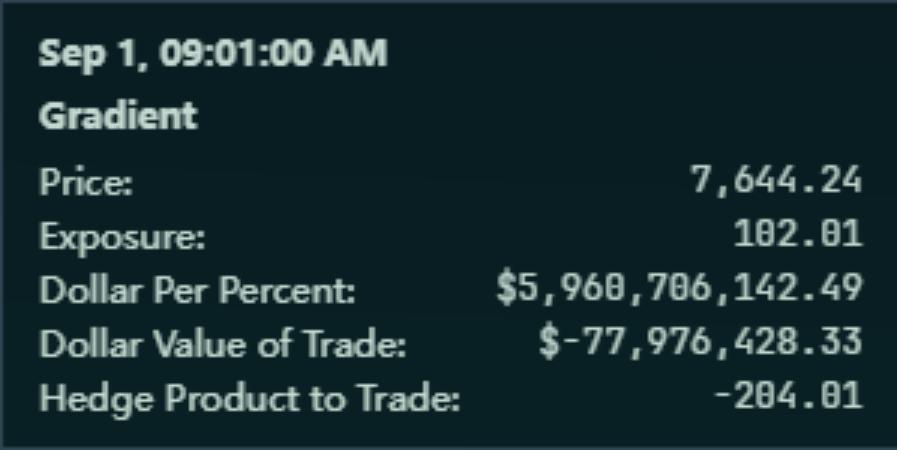
Each case starts from the position as it stood that morning, names the level that mattered and the decision made against it, then follows how the session played out, including the times it didn't work and how I handled them. New cases are added regularly.
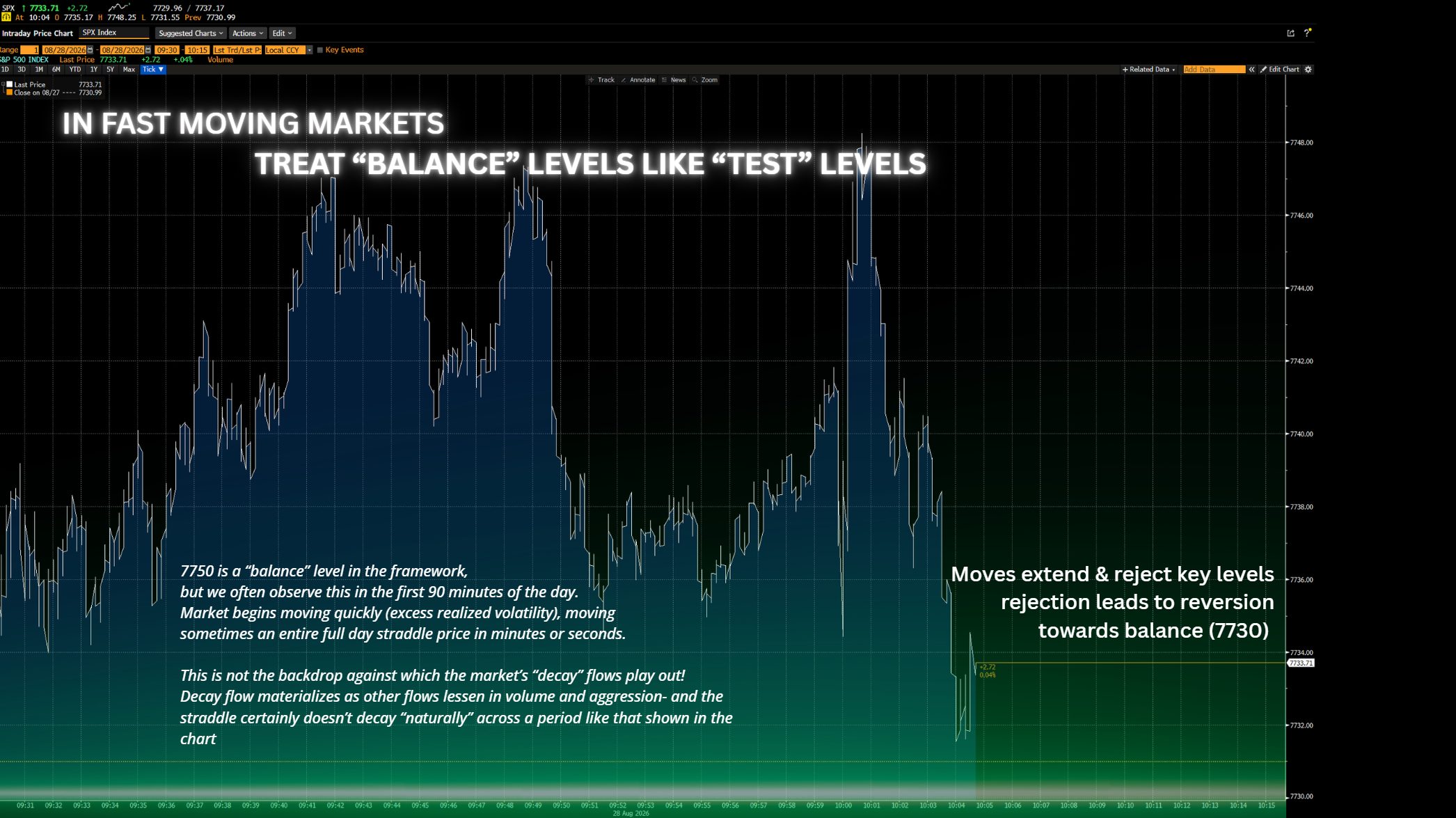
I'll be candid: one mistake people make all the time is trying to be precise. You don't need to be precise. A general sense of how big the influence is and which way it points is enough, and that's something you learn to see on a chart, without doing the math yourself.
The course is recorded, so it fits around a day job. You can watch it all in one night or take a month, and the labs are there when you want to go back. Account size doesn't change the read either. The boundaries and the balance point are the same whether you trade one contract or a hundred, and because the course teaches you to read the position for yourself, you fit it to your own account, your margin and the hours you can actually trade.
I have 0 clue about maths, but, as the days of education go on.. much more confidence daily. "How the fk are we going down STILL"...now I get it. (Same for upside)
I've been trading for a while now and honestly thought I had a decent handle on how markets move. Then I found VolSignals and realized I was basically flying blind. What changed everything for me was understanding dealer positioning. Like actually understanding it, not just reading headlines about gamma squeezes after they already happened. [...] I'm not a professional trader. I'm a firefighter managing my own retirement account and this has genuinely changed how I think about risk and timing. Stopped me from panic selling during a flush that I now understand was completely mechanical. [...] Highly recommend VS Pro if your serious about understanding what's actually driving markets.
I come from a completely different background (golf professional), but after 12 months with VS Pro, I can confidently say I know what I'm doing now [...] The team you've built is amazing. I've also started private classes with Nick, since his style fits my lifestyle well [...] I just wanted you to know that your teaching, and the whole VS Pro team, is genuinely building better traders.

I spent 15 years at Belvedere Trading leading the index desk as a capital partner. I built the firm's training program, oversaw the tech teams responsible for hedging and automated execution, and traded SPX on the floor, upstairs over the phones and on screens.
Matt spent his career managing some of the largest volatility books at some of the largest New York banks.
Dealer Hedging Dynamics is a recorded course that teaches people who trade SPX options or futures to read the market maker position and turn it into a daily map of where SPX is likely to top out, bottom out and settle.
Introduction and Gamma are free with an email address and a password, so you can judge the teaching before you buy. The full course is a one-time purchase, and you can watch it all in one night or take a month. There's no live session to attend. Every case published in your first 12 months is included, and after that new cases keep coming as long as you have an active VS Pro or VS3D subscription.
The dealer hedging phase of the VIP Mentorship, recorded on its own. If you apply to the Mentorship later, the full course price is credited toward it.
The full course opens on [opening date]. Sign up free and you're on the list, so you'll hear first when it opens.
Watch the two free modules first, and if the teaching isn't for you, don't buy the rest. It's a digital product and all sales are final, so I'd rather you decide on the free modules than on this page.
★★★★★4.4so over the past few weeks me being fully immersed in catching up on voltudies and DHD (before digging into vol mentorship). I have to say—WOW., i know im still in the early stages of the content but it’s completely reshaped my understanding and dismantled all the gex assumptions i learnt from other furus lmao
Paying VS Pro and VS3D members: ask for your member code before checkout. Codes are single-use and issued against an active, non-trial subscription.
The full course price is credited toward the VIP Mentorship if you apply later.
Digital product. All sales are final. The free tier is the preview.
It works, but it isn't a be-all end-all solution to your trading career. It equips you like a navigator with a map, and it's just a much better map than you're used to. I can give the exact same course and the exact same data to three different people and each one will trade it differently. Sharing it doesn't reduce its efficacy.
No. Introduction and the Delta module start from one trade and one hedge, and everything after that builds on those two. Watch Introduction and Gamma first, since they're free, and if they make sense to you the rest builds on them the same way.
That's up to you. The eight modules are recorded, so you can watch everything in one night or take a month, and the two labs and the case library are there to come back to.
No. The course teaches you to read the position and set the day's boundaries. What you trade against those levels, whether futures, options or spreads, and in what size, is fitted to your own account, margin and schedule, and the Trading module goes through how to choose.
Introduction and Gamma, including the single-option panel of the gamma lab and one scenario. Sign up with an email address and a password and log in at volsignals.com.
Checkout creates your member account and attaches the course plan. You set a password on the confirmation screen, log in at volsignals.com, and the course page opens. No access links are emailed.
No. Every module is recorded, and new case studies are added regularly.
No. The examples are shown inside the modules. A VS3D subscription lets you read the same position live, and it is not required.
Two self-contained simulators on frozen snapshots of real positions: the gamma lab (a single option, then a full position, then scenarios) and the charm lab (an expiring position on a clock with an implied volatility input). More labs are added over time.
Every case published in your first 12 months is included. After that, new cases continue as long as you have an active VS Pro or VS3D subscription, and you keep every case you already have.
No. This is a digital product and all sales are final. The free modules exist so you can judge the teaching before you buy.
Yes, for paying VS Pro and VS3D members. Ask for your single-use member code before checkout; it is issued against an active, non-trial subscription.
Yes. The full course price is credited toward the VIP Mentorship when you apply. It is applied by hand at mentorship checkout.
Introduction and Gamma are free. Sign up now and you're on the list for [opening date], when the full course opens.
Hear what the VolSignals community is saying.
Testimonials reflect individual members' experiences and are not typical results or a guarantee of future performance. VolSignals provides educational content only, not investment advice. Trading options and futures involves substantial risk of loss.
Made by craze&friends. © 2026 Volsignals. All rights reserved.

